From Activity to Impact: The Modern Software Engineering KPI Guide
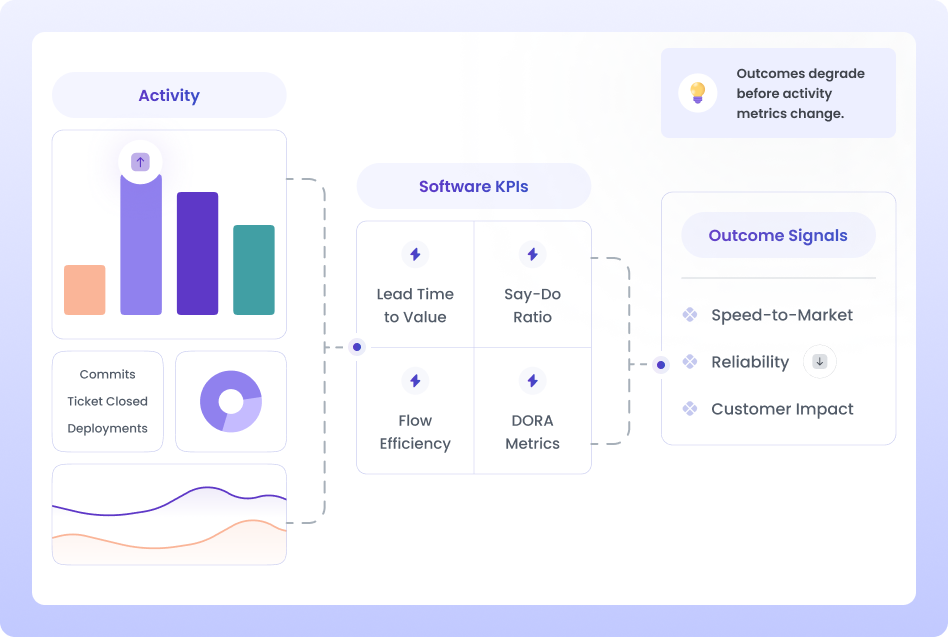
What Are Software Development KPIs and Why Most Dashboards Fail Engineering Leaders
Most engineering teams are equipped with dashboards full of numbers and charts, yet only a small portion of those signals are real software development KPIs.
Software development KPIs are outcome-focused signals that explain how the engineering system behaves over time and how that behavior connects to business results like speed-to-market, reliability, and customer impact.
When leaders ask simple questions like:
- Why are releases slipping even though teams look busy?
- Why did the quality drop after adding more engineers or AI tools?
- Are we actually moving faster, or just producing more activities?
Traditional dashboards go quiet.
This gap exists because most teams don’t lack data. They lack decision-grade indicators.
Software development KPIs exist to fill that gap.
- They are not tracking tools.
- They are not surveillance mechanisms.
- And they are not meant to evaluate individual developers.
This guide is designed to help engineering leaders move from reporting metrics to using KPIs as decision tools. If your dashboards look healthy but delivery still feels fragile, slow, or unpredictable, this guide will help you understand why.
What Actually Are Software Development KPIs - And Why Do They Exist?
Software teams measure a lot. But very few of what they measure deserved to be called KPIs.
Software development KPIs are outcome-focused indicators that show how your engineering system performs as a whole. They tell you whether delivery, quality, stability, and reliability are improving over time.
Activity metrics like LOC are just noise. What leaders really need are signals that capture business value.
Deployment Frequency, Lead Time for Changes, Change Failure Rate, and MTTR. Together they balance speed and stability.
Weekly for anomaly detection, monthly for trend analysis, quarterly for strategic alignment.
Yes — DORA metrics are more important in the AI era because they measure actual delivery outcomes, not just code generation speed.

Reveal Invisible Roadblocks
Uncover hidden productivity bottlenecks in your development workflow
Review Efficiency
Streamline code review processes to improve efficiency and reduce cycle times


"The only tool our entire leadership team actually trusts"